Rosalina vs Cajeput and Niaouli: Melaleuca Oils Compared
Rosalina, cajeput and niaouli sound like three different families, and on a shop shelf they often look like it. Botanically they are cousins: all three come from the paperbark genus Melaleuca, the same genus that gives us tea tree. What separates them is chemistry, and a single study that put several Melaleuca oils through the same instrument makes the point better than any description of smell can.
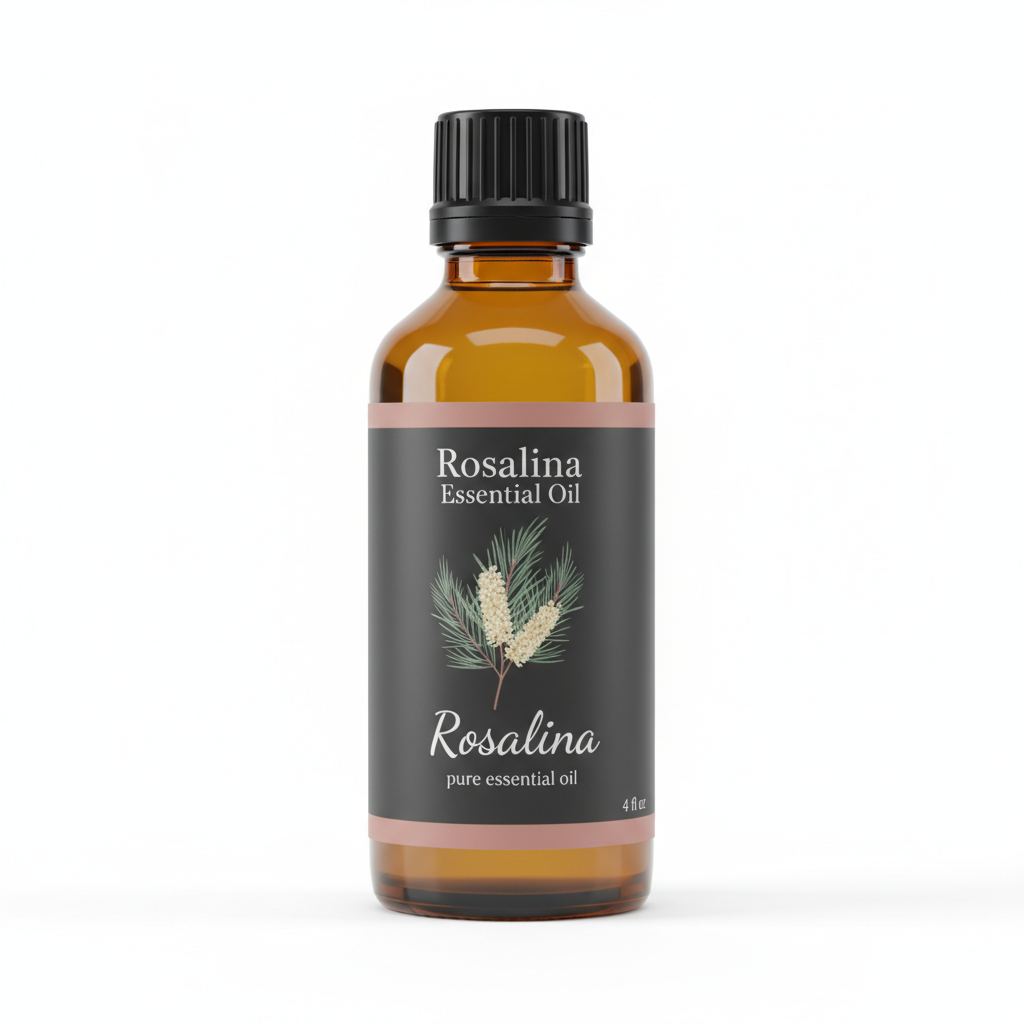
Rosalina Essential Oil
Our own Rosalina Essential Oil, in sizes from 0.5 oz to bulk.
From $16.99
Shop Now →Who is who
- Rosalina is Melaleuca ericifolia, the swamp paperbark of south-eastern Australia.
- Cajeput is Melaleuca cajuputi, and the oil is commonly sold under that name.
- Niaouli is the trade name for Melaleuca quinquenervia oil.
Common names are looser than Latin binomials, so the Latin name is the line to read on a label. Our label guide explains why.
One study, four profiles
In 2023 researchers in Molecules compared seven tea tree oils with four other Melaleuca oils by gas chromatography and mass spectrometry. Tea trees clustered tightly around terpinen-4-ol (37.66% to 44.28%). The others did not cluster at all. The cajeput oil had 1,8-cineole at 64.63%. One niaouli (M. quinquenervia) oil was led by (E)-nerolidol at 48.40% with linalool at 33.30%, while a second niaouli had 1,8-cineole at 52.20%. The rosalina oil had linalool at 38.19% and 1,8-cineole at 27.57%.
That is what a Melaleuca oil really is: a family of oils with overlapping ingredients and different centres of gravity. Niaouli shows the same thing within one species. Work on 300 niaouli samples from 75 trees in Benin found three chemotypes: one with about 50% 1,8-cineole, one with about 33% cineole and 32% viridiflorol, and one with about 50% viridiflorol. The authors reported the composition stable across seasons, which means the chemotype belongs to the tree, not the weather.
What this means for your nose
Cineole smells camphor-like and clear; linalool smells floral, similar to bergamot oil and French lavender, according to PubChem. So a cineole-led cajeput tends to read bright and penetrating, a cineole-led niaouli similar, and a linalool-leaning rosalina softer, though the Ecuadorian rosalina in a 2026 paper had 61.85% cineole and 0.49% linalool, which would smell nothing like a floral oil. Species are only a rough guide. The same species can pull in two directions. This is why our tea tree comparison talks about numbers, not names.
Our own description of our rosalina is a soft, fresh aroma with a green opening and a floral, lavender-like sweetness, and it is sold as a single steam-distilled oil. We do not sell cajeput or niaouli; a craft supply shop or an aromatherapy supplier will have them. The overview of rosalina covers what we do offer.
How to choose between them
- Pick by smell first. Sniff on a paper strip over an hour. The opening and the dry-down are different stories.
- Ask for the Latin name and the profile. If the seller cannot say which species or show the main constituents, you cannot know which kind of oil you hold. Our GC-MS guide shows how to read one.
- Dilute the same way. These are concentrated oils. For skin, we suggest 0.5% to 2% in a carrier oil with a patch test first, and keeping them away from eyes, children and pets. Do not swallow any of them.
The EFSA scientific opinion on cajuput oil as a feed additive, published in 2024, set species-specific limits in animal feed and included a maximum of 5 mg per kg of complete feed for cats, against 30 mg per kg for dogs, so species differ a great deal. That is a feed-additive figure, not household guidance, and the practical advice for pets is the same for all three oils: ask a veterinarian.
Three oils from one genus, then, and three different bottles. Choose the one whose smell fits the room, and let the Latin name and the numbers do the rest.
Rosalina Essential Oil
Rosalina Essential Oil from our own shop, in sizes from 0.5 oz to bulk.
From $16.99
Shop Now →Sources & Further Reading
- HPTLC Analysis and Chemical Composition of Selected Melaleuca Essential Oils
- Chemotypes in Melaleuca quinquenervia (Cav.) S.T. Blake (Niaouli) from Benin using multivariate statistical analysis of their essential oils
- Safety and efficacy of a feed additive consisting of an essential oil derived from fresh leaves of Melaleuca cajuputi Maton & Sm. ex R. Powell and Melaleuca leucadendra (L.) L. (cajuput oil) for use in all animal species (FEFANA asbl)
- Essential Oil of Melaleuca ericifolia Sm.: Chemical Composition, Enantiomeric Distribution, and Antimicrobial, Antioxidant, and Anticholinesterase Activities