Rosalina Diffuser Blends: Six Four-Drop Pairings
A good diffuser blend is rarely long. Two or three oils, a handful of drops, and a clear idea of what each one is doing. Rosalina makes a pleasant base for that because it is soft, fresh and lavender-like, with a green opening and a floral sweetness. Here are six ways to pair it, each worked out on paper in four drops.
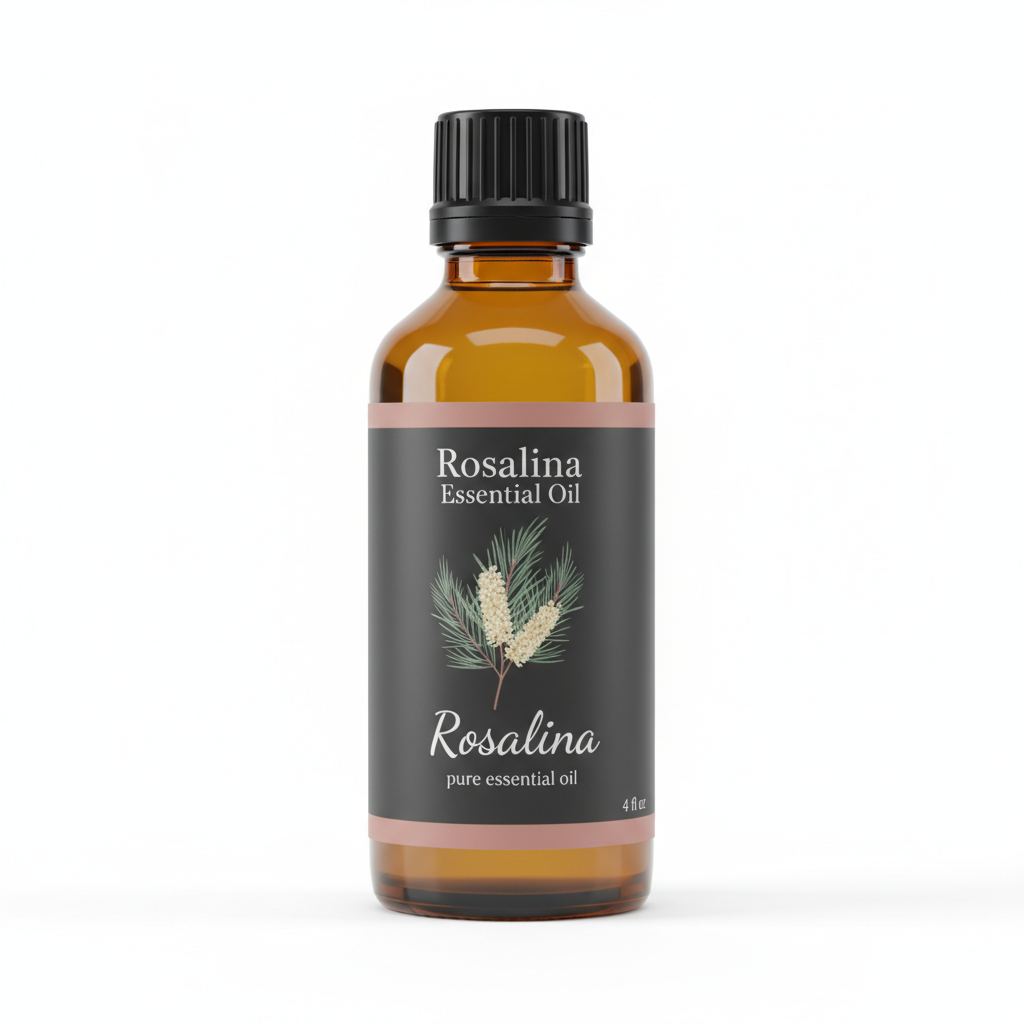
Rosalina Essential Oil
Our own Rosalina Essential Oil, in sizes from 0.5 oz to bulk.
From $16.99
Shop Now →We sell one oil, rosalina, so the partners come from a craft shop, pharmacy or aromatherapy supplier. These are formulations built from published guidance and arithmetic, so adjust them to your nose.
Know your starting point
Smell your rosalina on a paper strip first. If it reads floral, partners that add brightness or wood will make the most interesting blend. If it leans camphor-like, which the literature shows is possible for this species (Valarezo et al., 2026), pair it with something floral or sweet. Our guide to what rosalina smells like explains the strip method.
Six pairings for a 100 ml tank
The Tisserand Institute's support team gives a rule of thumb of 3 to 5 drops of oil per 100 ml of water, as a starting guideline (Tisserand Institute, Essential Oil Applications | Inhalation, Diffusion and Topical Applications). These recipes stay at four drops in total.

| Blend | Drops | What the partner adds |
|---|---|---|
| Rosalina and mandarin | 2 + 2 | A bright citrus lift over a green heart |
| Rosalina and lavender | 2 + 2 | More floral depth; lavender shares linalool with a floral rosalina |
| Rosalina, lavender and geranium | 2 + 1 + 1 | A rounder, rosier floral |
| Rosalina and clary sage | 3 + 1 | A herbal edge, kept light |
| Rosalina and chamomile | 3 + 1 | A soft, sweet finish |
| Rosalina and bergamot | 2 + 2 | Citrus with a floral lift |
Linalool, the floral molecule in lavender, is described as similar to bergamot oil and French lavender (PubChem, Linalool (compound 6549)), which is why these pairings sit comfortably together. The citrus partners bring limonene, which the same reference describes as lemon-like (PubChem, Limonene (compound 22311)), and that is the lift in the table.
How to choose among the six
Pick by the kind of smell you want in the room that day. Mandarin or bergamot give a bright, zesty lift; lavender and geranium lean floral; chamomile is sweet and soft; clary sage keeps things herbal. None of these is a rule, only a starting point for a nose that knows what it likes.
If you are unsure, begin with the two-oil pairings. Add the second oil last, one drop at a time, and smell in between so you know which drop changed things.
Where we would hold back
Eucalyptus is on our list of partners, but it deserves a thoughtful hand. Its main compound is 1,8-cineole, which is camphor-like (PubChem, 1,8-Cineole (compound 2758)), and a rosalina that already leans that way would only double the sharpness. We would use it sparingly, if at all, and keep it away from young children's rooms; our article for cautious parents explains why.
Smell the pair before the tank
Before anything goes into water, put one drop of each oil on separate paper strips and hold them together under your nose. It takes a minute, and it tells you whether the pairing works before you have committed a tankful.
Scaling the drops
The rule scales with water. A 300 ml tank gives 9 to 15 drops in total by the same arithmetic, so a 5 + 5 split with 10 drops sits comfortably in the middle. Resist adding more because the scent seems to fade after a few minutes: noses tire quickly, so step out of the room and back in to judge. Our drops in a diffuser article covers conversions.
Running the diffuser for 30 to 60 minutes and then pausing for 30 to 60, with a little fresh air in the room, is the Tisserand safety guidance (Tisserand Institute, How to Use Essential Oils Safely). Notes help too: jot down the date, tank size, drops and what you smelled at ten minutes and an hour, so a blend you love can be repeated.
A blend written down is a blend you can share. If a friend loves one of these pairings, send them the drops and the tank size rather than just the names, since the same four drops behave differently in a small tank and a large one. And if something turns out less pleasing than you hoped, treat it as a draft, change a single drop, and try again tomorrow when your nose is fresh.
Keep the room and the equipment in mind
In a chamber study of an ultrasonic diffuser, a 15-minute run released about 2.6 mg of limonene with lemon oil and about 3.5 mg of eucalyptol with eucalyptus oil, and tap water instead of deionised water raised fine particle emission about fivefold in the eucalyptus run (Schwartz-Narbonne et al., 2021). It was one chamber and a few oils, so we take it as a reminder to follow your diffuser maker's water guidance and keep the tank clean. Our cleaning guide shows how.
Keep bottles out of the sight and reach of children and pets, as Poison Control advises (Poison Control, Essential oils: Poisonous when misused), and ask a veterinarian or physician first if animals, pregnancy or a respiratory condition are in the picture. Our diffuser types comparison helps if you are choosing a unit.
Start with the pairing that sounds most like your favourite room, run it short, and change one drop at a time.
Rosalina Essential Oil
Rosalina Essential Oil from our own shop, in sizes from 0.5 oz to bulk.
From $16.99
Shop Now →Sources & Further Reading
- Valarezo E. et al., 2026. Essential Oil of Melaleuca ericifolia Sm.: Chemical Composition, Enantiomeric Distribution, and Antimicrobial, Antioxidant, and Anticholinesterase Activities. Molecules. Europe PMC PMC13666404
- PubChem, Linalool (compound 6549)
- PubChem, 1,8-Cineole (compound 2758)
- PubChem, Limonene (compound 22311)
- Tisserand Institute, Essential Oil Applications | Inhalation, Diffusion and Topical Applications
- Tisserand Institute, How to Use Essential Oils Safely
- Poison Control, Essential oils: Poisonous when misused
- Schwartz-Narbonne H., Du B. and Siegel J.A., 2021. Volatile organic compound and particulate matter emissions from an ultrasonic essential oil diffuser. Indoor Air. Europe PMC 33905580