How to Clean an Essential Oil Diffuser, Step by Step
A diffuser that has quietly stopped misting, or one that smells faintly stale, is almost always asking for a clean, not a replacement. The good news is that a tidy routine takes a few minutes, and the advice from makers and public health sources lines up on the big points: keep the water fresh, wipe away oily film, and let everything dry.
Rosalina Essential Oil
Our own Rosalina Essential Oil, in sizes from 0.5 oz to bulk.
From $16.99
Shop Now →Know your machine first
The right cleaner depends on the type. An ultrasonic diffuser holds water, a nebulizer holds neat oil and no water, and a reed diffuser has no machine at all (our diffuser types comparison shows the differences). We sell oil rather than diffusers, so your manual is the authority. One ultrasonic manual we read says not to use detergents, solvents or abrasive products on the device, while other brands recommend vinegar or alcohol, which only goes to show that different machines want different care.
Ultrasonic diffusers: keep the water clean
An ultrasonic diffuser is a small ultrasonic humidifier with a little oil added, so humidifier guidance is a helpful guide. The US EPA suggests emptying the tank, wiping every surface dry and refilling portable units daily, using water low in minerals such as bottled water labelled distilled, and cleaning portable units every third day to keep scale and microorganisms from building up. If you use a cleaning agent, rinse the tank thoroughly with several changes of water (US EPA). Where a manufacturer gives no advice, the EPA names a 3% hydrogen peroxide solution for surfaces that touch water.
Distilled water has a second benefit. In a chamber study of an ultrasonic essential oil diffuser, particle emissions with eucalyptus oil were about five times higher with tap water than with deionised water (Schwartz-Narbonne et al., 2021). Minerals matter, in other words, for the machine and for the air.
A simple routine
- Unplug the unit and empty the tank. Keep water away from the base and any fan or electronics.
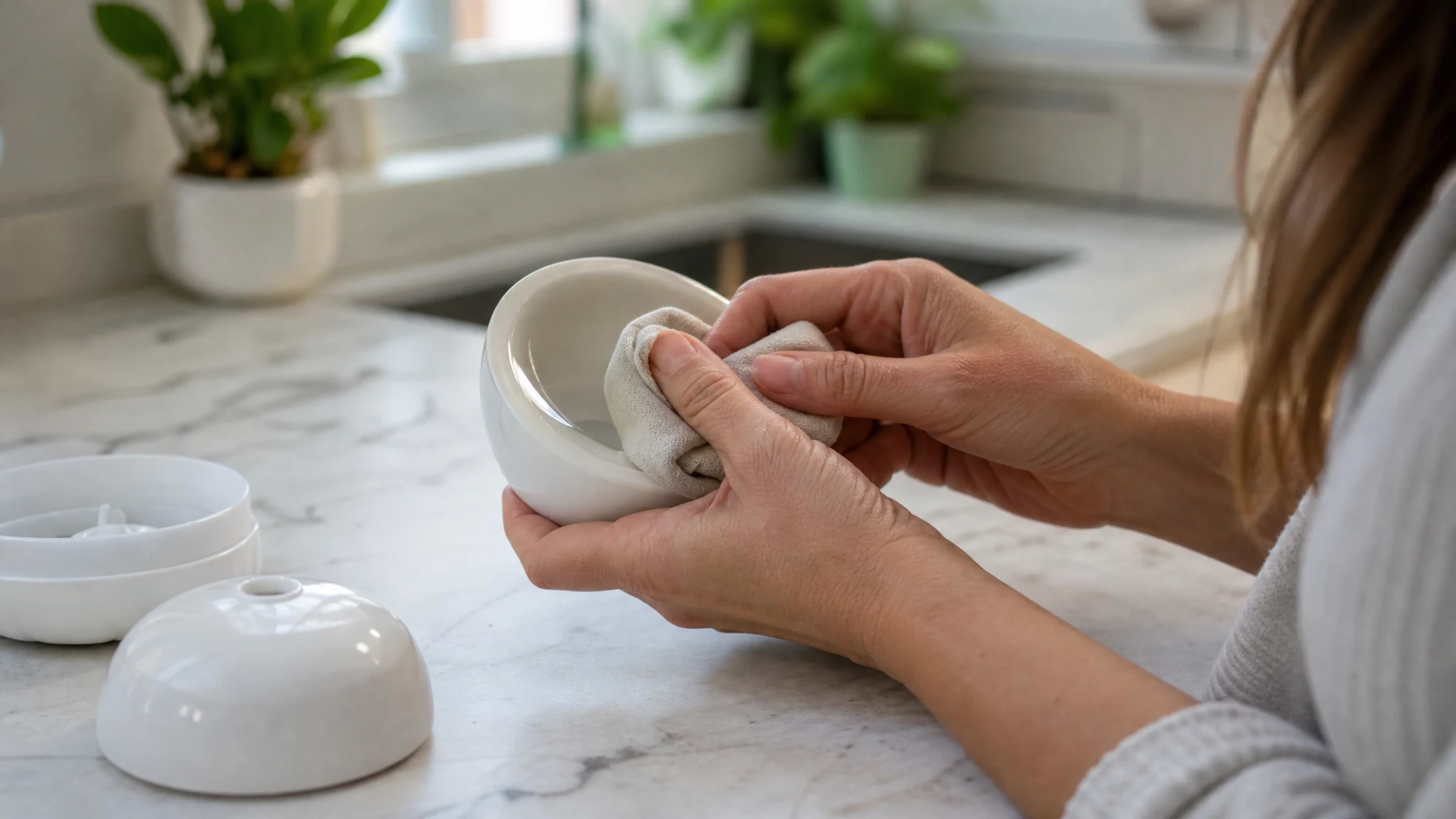
- Wipe the tank and the ultrasonic plate with what your manual allows. A damp cloth works for most. Some makers suggest a cotton bud with a few drops of alcohol on the plate.
- Use a vinegar soak if your manual does. Vitruvi, for example, describes filling the reservoir part way with white vinegar and leaving it for about half an hour before rinsing (Vitruvi). Rinse well afterwards so no vinegar scent lingers.
- Wash the cover only as its material allows, such as a ceramic lid in soapy water.
- Dry completely and leave the lid off until it is dry.
- Refill with distilled water next time, and empty the tank after each session.
Make it a two-minute habit
The routine above looks longer on paper than it is. Keep a small cloth and a cotton bud near the machine, and the rinse, wipe and dry takes about as long as making a cup of tea. We like to do it right after a session, while the water is still easy to tip out and nothing has had time to dry into a film.
Look at the plate in good light, tilted a little, since a thin film is easier to see from the side than from above. If the mist looks weaker than it used to, that is usually the first sign. Run a fingertip along the inside edge of the tank, and if it feels slick or gritty, give it a proper clean now and not next week.
Store the diffuser with the lid off or ajar so air can get in and the tank stays dry between uses. A diffuser that is dry when you put it away is nearly always pleasant when you take it out again.
How often?
Sources vary. The EPA says every third day for humidifiers, and diffuser makers range from weekly to monthly depending on the model and how often you run it. We think the cautious choice is to follow the more frequent schedule if you run the machine daily, and to clean it whenever the mist weakens or the water looks cloudy. A quick rinse and dry after each use is the easiest habit of all.
Nebulizers and reed diffusers
A nebulizer holds no water, so alcohol is the usual cleaner. Organic Aromas, for its own glass units, suggests running a splash of isopropyl alcohol of 90% or stronger through the unit for a few minutes, emptying it, wiping with a lint-free cloth and letting it air-dry before the next oil. It advises against soap and water on a unit designed to stay dry (Organic Aromas). Reed diffusers hold their oil in an alcohol-based liquid, so there is nothing to scrub; replace the reeds when they stop wicking and keep the liquid away from children and pets (Poison Control).
Why residue builds up
Makers describe the same story: the lighter parts of an oil evaporate first, and heavier components left behind slowly oxidise into a sticky film. Rosalina oil, like other Melaleuca oils, changes with exposure to air, which is why we suggest storing it cool, dark and tightly capped. The practical lesson for the diffuser is to use the low end of your manual's drop count; fewer drops leave less film. Our diffuser drops guide shows how to work the number out.
When something looks wrong
If you see pink or black growth, discard the water and clean thoroughly before running the machine again. If anyone at home has asthma or another lung condition, check with their physician before restarting it. For setup and timing, see how to use an essential oil diffuser, and for keeping the bottle in good shape, our storage guide.
A clean diffuser, fresh water and a few well-chosen drops make for a much nicer room, and it only takes a few minutes.
Rosalina Essential Oil
Rosalina Essential Oil from our own shop, in sizes from 0.5 oz to bulk.
From $16.99
Shop Now →Sources & Further Reading
- US EPA. Use and Care of Home Humidifiers. epa.gov
- Schwartz-Narbonne et al., 2021. Volatile organic compound and particulate matter emissions from an ultrasonic essential oil diffuser. Indoor Air. Europe PMC
- Vitruvi. How to Clean Your Diffuser. vitruvi.com
- Organic Aromas. How to Clean Your Nebulizing Diffuser. organicaromas.com
- Poison Control. Essential oils: Poisonous when misused. poison.org