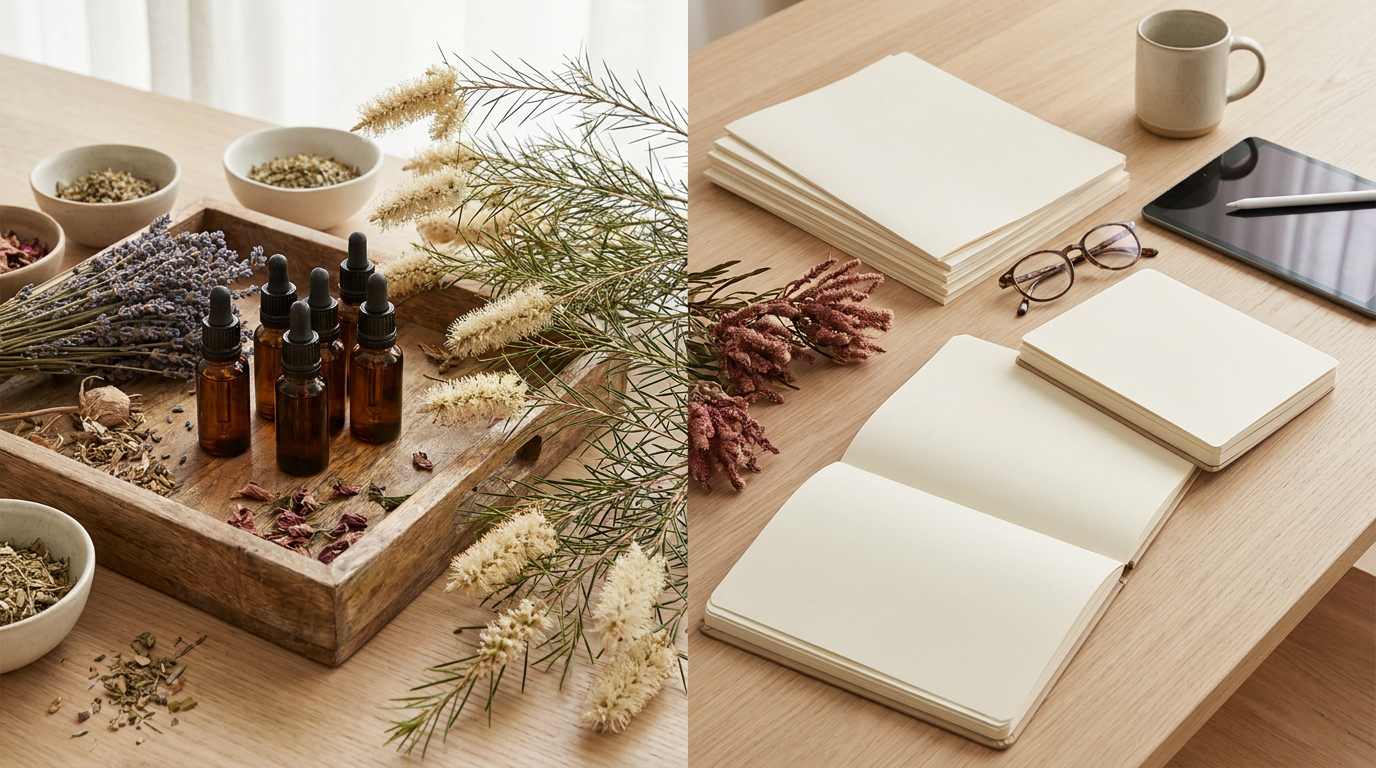
The Quiet Grove Blend: Our Signature Rosalina, Cedar, and Lavender Mix
Some blends arrive fully formed, as if the oils were always meant to sit together. This is one of them. Rosalina, cedarwood, and lavender share a quiet botanical coherence: each oil is soft-voiced, each carries a kind of earthy brightness, and together they settle into something that feels less like a perfume and more like a place. Specifically, a grove just after rain.
This rosalina blend recipe grew out of an experiment with a single drop of each on a scent strip, late on a grey afternoon. The result was immediate and persuasive. We have refined the ratios since then, but the character stayed the same: calm without being flat, green without being sharp, woody without being heavy. It has become our most-reached-for signature essential oil blend for diffuser work, roller bottles, and linen sprays alike.
Below you will find the full recipe, step-by-step blending instructions, dilution guidance, safety notes, and three variations to take it in different directions depending on your mood or the season.
Why This Particular Combination Works
Before we get into measurements, it is worth spending a moment with each ingredient individually. A blend is only as coherent as its parts, and understanding what each oil contributes helps you adjust confidently later.
Rosalina: The Heart of the Blend
Rosalina (Melaleuca ericifolia) is distilled from the leaves and terminal branches of a paperbark tree native to coastal southeastern Australia. Its aroma sits at an intriguing crossroads: softer and more floral than tea tree, with a gentle camphoraceous lift and a faintly sweet, almost rosy undertone. That floral-woody duality is precisely what makes it so well-suited to anchoring this blend. It bridges the brighter lavender and the deeper cedarwood without competing with either.
If you are new to this oil, our complete guide to rosalina oil uses is a good place to start before building your first rosalina lavender blend.
Cedarwood Atlas: The Woody Base
We use Cedarwood Atlas (Cedrus atlantica) here rather than Virginian or Himalayan cedarwood. Atlas has a creamier, slightly balsamic quality that blends more smoothly with florals. Virginian cedar tends to be sharper and more pencil-shaving dry, which can overpower rosalina's softness. Himalayan cedar is lovely but harder to source consistently. Atlas threads in here like a quiet bass note: you feel it more than you hear it.
Lavender: The Bridge
True lavender (Lavandula angustifolia), ideally from a high-altitude source such as Provence or Bulgarian origin, provides the linalool-rich floral character that ties rosalina and cedarwood together. Its familiar softness is not a cliche in this context. It earns its place by softening the camphoraceous edge of the rosalina while lifting the heaviness that cedar can sometimes carry in larger proportions.
The Full Ingredient List
This recipe produces a 10 ml concentrate. From this concentrate you can make a diffuser blend, a roller bottle, or a room spray by adjusting your carrier accordingly (more on dilution below).
| Ingredient | Drops | Approximate Volume (ml) | Role in Blend |
|---|---|---|---|
| Rosalina essential oil | 20 drops | 1.0 ml | Heart note, botanical bridge |
| Cedarwood Atlas essential oil | 14 drops | 0.7 ml | Base note, woody depth |
| Lavender (true) essential oil | 16 drops | 0.8 ml | Top-to-heart note, floral softener |
Total concentrate: approximately 2.5 ml of essential oil blend. Store this in a 5 ml or 10 ml amber glass bottle. You will have room to scale up the recipe directly in a larger bottle if you prefer working in bigger batches.
Step-by-Step Blending Instructions
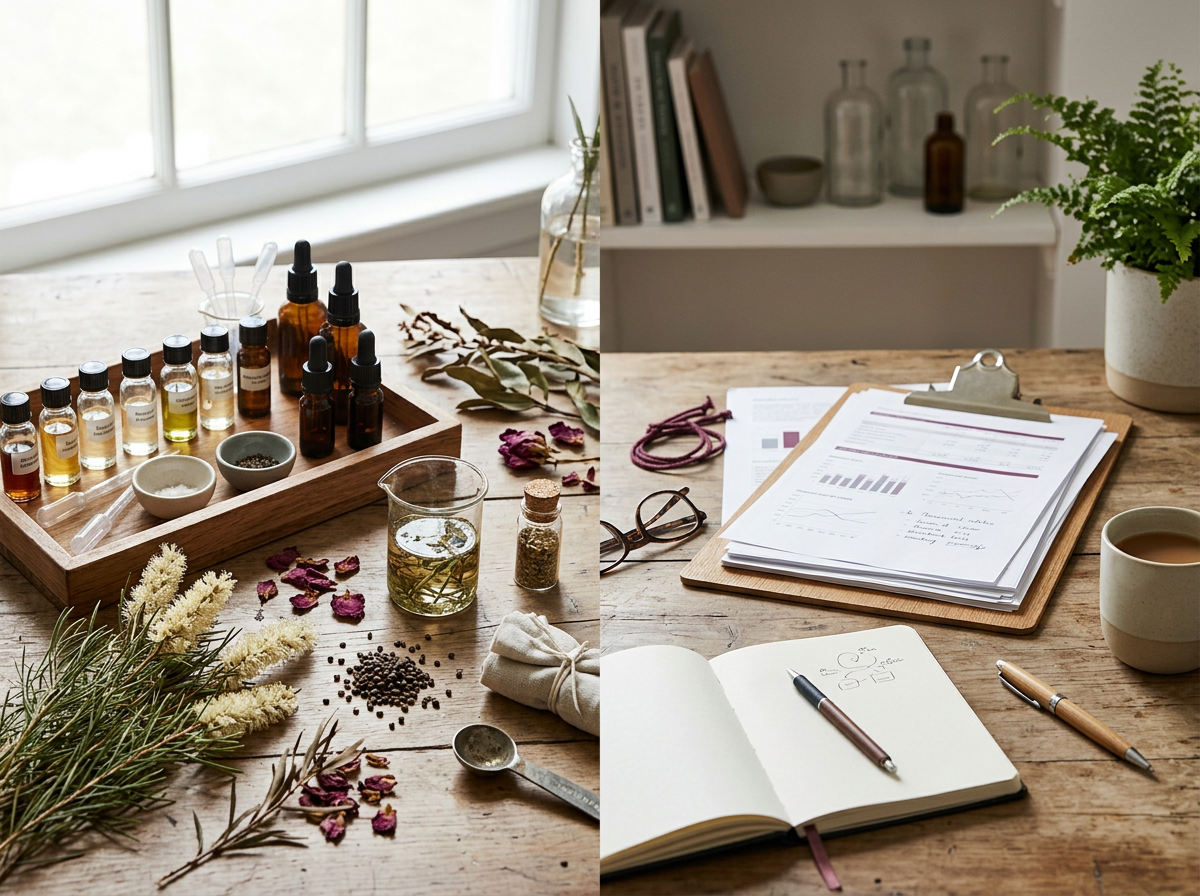
- Gather your materials. You will need: a 5 ml or 10 ml amber glass bottle with an orifice reducer, a dropper or pipette, a scent strip or cotton round for testing, a pen and label, and a small notepad if you like to keep records of your batches.
- Blend base notes first. Add your 14 drops of Cedarwood Atlas to the bottle. Working from the heaviest, slowest-evaporating oil first is a common blending practice. It gives you a reliable foundation.
- Add the heart note. Drop in 20 drops of rosalina. Gently swirl the bottle once or twice. Do not shake vigorously at this stage.
- Add lavender last. Drop in 16 drops of true lavender. Place the orifice reducer and cap on the bottle, then roll gently between your palms for about 20 seconds to encourage the oils to combine.
- Let it rest. Set the capped bottle aside for at least 24 hours before making your final evaluation. Essential oil blends shift as they marry. What smells slightly camphoraceous right after blending often smooths considerably after a day of rest.
- Test on a scent strip. After resting, place one drop on a scent strip and smell it at intervals of 5 minutes, 20 minutes, and 1 hour. Note how the dry-down changes. This is where you decide if you want to adjust the ratio before scaling up.
- Label your bottle. Write the blend name, date, and batch number. Concentrate bottles are easy to mix up. Good habits here save frustration later.
Dilution Ratios and How to Use This Blend
This recipe produces a 100% essential oil concentrate. You must dilute it before applying to skin. Below are suggested dilution guidelines based on intended use.
For a Roller Bottle (Topical Use)
- Standard adult dilution (2%): Add 12 drops of concentrate to 30 ml (1 oz) of carrier oil such as fractionated coconut oil, jojoba, or sweet almond oil.
- Sensitive skin dilution (1%): Add 6 drops of concentrate to 30 ml of carrier oil.
- Do not apply undiluted essential oils directly to skin.
For a deeper look at how rosalina performs in skin-care applications, see our article on rosalina oil for skin.
For a Diffuser
- Add 4 to 6 drops of concentrate to a standard 100 ml ultrasonic diffuser filled with water.
- Run in 30-to-60-minute cycles with breaks, particularly in smaller rooms.
- Avoid continuous diffusion around pets, young children, or during sleep without ventilation.
For a Room or Linen Spray
- Combine 15 drops of concentrate with 5 ml of high-proof grain alcohol (such as Everclear) to help disperse the oil in water.
- Add to a 100 ml glass spray bottle and top up with distilled water.
- Shake before each use.
- Spritz lightly on linens, soft furnishings, or into the air. Allow fabrics to dry before contact with skin.
If you are working with a smaller living space, our guide on rosalina for renters has room-by-room ideas for using this kind of signature essential oil blend without overwhelming a compact interior.
Patch Testing and Safety Notes
Patch testing is non-negotiable before any new topical blend, even one built from familiar oils.
How to patch test: Apply a small amount of your diluted blend (not the concentrate) to the inside of your forearm or behind your ear. Leave it undisturbed for 24 hours. If you notice any redness, itching, or irritation, rinse thoroughly with cool water and a mild soap, and discontinue use of that blend.
Key safety notes for this blend:
- Rosalina contains linalool and 1,8-cineole. Both are generally considered well-tolerated at proper dilutions, but cineole-rich oils are not recommended for direct application near the faces of young children or infants.
- Cedarwood Atlas should be avoided during pregnancy. Consult a qualified healthcare provider before using any essential oil blend if you are pregnant, nursing, or managing a health condition.
- Keep all essential oils, concentrates, and diluted products out of reach of children and pets.
- For diffuser use around cats specifically: cedarwood and other conifer-family oils warrant caution. Consult a veterinarian if you have concerns.
- Do not use near open flame.
Storage and Shelf Life
Store your concentrate in a sealed amber or violet glass bottle, away from direct light and heat. A cool, dark drawer or cabinet is ideal. Avoid storing essential oil blends in the bathroom, where humidity and temperature fluctuate.
Expected shelf life of the concentrate: Up to 2 years from the date of blending, provided the bottle is kept properly sealed. Cedarwood Atlas is a relatively stable oil and can actually improve slightly with age. Lavender and rosalina are reasonably stable but will begin to oxidize over time, particularly once the bottle is frequently opened.
For diluted roller bottles and sprays: Use within 3 to 6 months. Label with the date of preparation. If the scent shifts noticeably or the carrier oil smells off, discard and make a fresh batch.
Three Variations to Try

Variation 1: The Deeper Grove (Winter Version)
Reduce lavender to 10 drops and cedarwood to 10 drops. Add 8 drops of Vetiver (Vetiveria zizanoides) and 6 drops of Black Spruce (Picea mariana). Keep the rosalina at 20 drops. The result is earthier and more resinous, with a dark greenness that suits cold months, evening diffusion, and wool blankets.
Variation 2: The Bright Grove (Spring Version)
Keep rosalina at 20 drops and lavender at 16 drops. Reduce cedarwood to 8 drops. Add 8 drops of Bergamot (Citrus bergamia, furocoumarin-free for topical use) and 4 drops of Clary Sage (Salvia sclarea). This version is lighter and more citrus-forward, with a cheerful lift that works well in a daytime diffuser or a morning shower steam.
Variation 3: The Soft Grove (Bedtime Wind-Down Version)
Reduce rosalina to 14 drops and cedarwood to 10 drops. Increase lavender to 20 drops. Add 6 drops of Roman Chamomile (Anthemis nobilis). This variation leans soft and powdery, with a quieter aromatic presence suited to a bedtime wind-down diffuser blend or a linen spray for pillowcases.
A Note on Sourcing
The quality of a rosalina lavender blend like this one depends heavily on the quality of each oil individually. Rosalina sourced from wild-harvested or small-scale Australian producers tends to have a more nuanced, rosy character than commodity-grade material. Cedarwood Atlas from sustainably managed Moroccan or Algerian forests carries a cleaner, more refined woodiness. Lavender from high-altitude cultivation will be more complex and less synthetic-smelling than lower-altitude or lavandin-substituted versions.
When you invest in well-sourced oils, the blend does more of the work on its own. The ratios above were developed with high-quality material. If you find the cedarwood is dominating, reduce it by 2 to 4 drops before assuming the ratio is wrong. Oil character varies meaningfully between producers and harvest years.
Blending as a Ritual
There is something genuinely absorbing about the process of building a signature essential oil blend from scratch. The careful measuring, the waiting, the quiet evaluation on a scent strip. It asks you to slow down and pay attention in a way that feels worthwhile even before you smell the result.
The Quiet Grove blend has become a kind of anchor scent in our studio. We reach for it when we want the air to feel considered without being elaborate. It does not try to impress. It simply makes a room feel like somewhere you would want to stay a little longer.
We hope it does the same for yours.